

Same Valley, Twice: Himalayan hydropower is carrying glacier risk it has not priced
Five Nepal hydropower plants were damaged by glacier floods in July 2025 and again in August 2026. Less than 5% of the loss is insured. HEF analysis.
HEF Research
7 min read
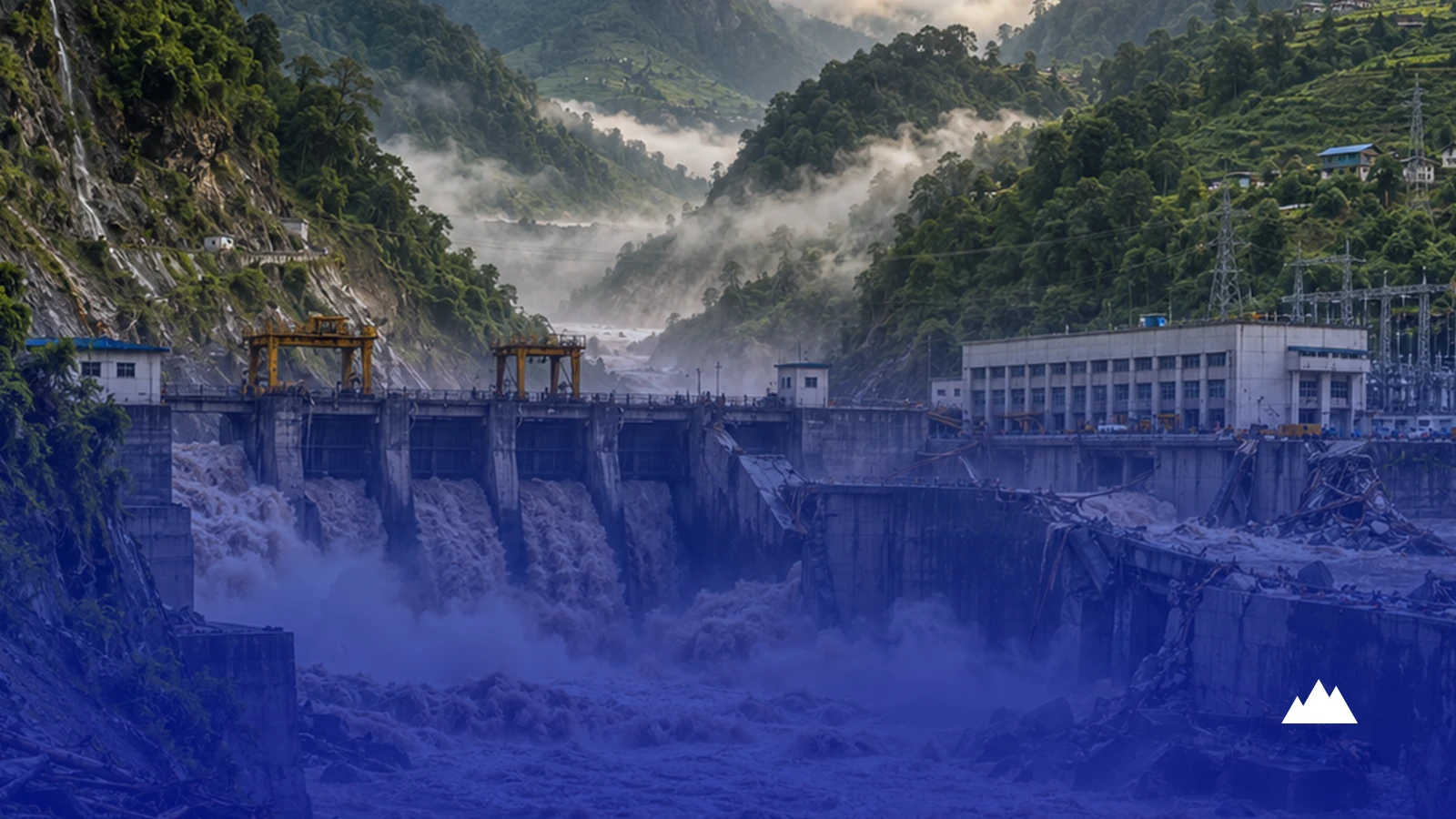
Five operating hydropower plants on Nepal's Trishuli–Bhotekoshi corridor, with 231 MW of capacity between them, were damaged twice in fourteen months, once by a glacial lake flood in July 2025 and again by a glacier collapse in August 2026. Two large projects under construction on the same river were also hit both times. Damage on this scale, repeated this quickly, points to a location risk that the finance, insurance and planning around these plants do not yet reflect.
The same valley, twice
On 8 July 2025, a supraglacial lake about 35 km inside Tibet drained into the Bhotekoshi. The flood knocked out five operating plants and three under construction, and officials put the generation lost at between 240 and 260 MW (Khabarhub (opens in a new tab), Stimson Center (opens in a new tab)). At Rasuwagadhi (111 MW), the gates and headworks were destroyed.
On 26 August 2026, a slab of rock and glacier ice broke from the north face of Langtang Lirung and fell about 1,200 m into the Lhende Khola valley, where it turned into a debris flow (ICIMOD (opens in a new tab)). The Independent Power Producers' Association, Nepal (IPPAN) lists 15 damaged projects with 753 MW of capacity (Ratopati (opens in a new tab)). They include all five operating plants hit in 2025, as well as Upper Trishuli-1 (216 MW) and Upper Trishuli-3B (37 MW), which are under construction. At Rasuwagadhi, the powerhouse and substation were reported completely destroyed (Urja Khabar (opens in a new tab)). Reported deaths range from more than 390 (ICIMOD (opens in a new tab)) to over 1,200 (Reuters (opens in a new tab)).
The corridor had shown its hazard a year before the collapse, and the plants were still in its path.
A pattern on both sides of the border
Repeat damage is not limited to Nepal. Two Indian projects have a similar record.
Tapovan–Vishnugad (520 MW, under construction), Uttarakhand. The June 2013 floods washed away its diversion tunnel (Down To Earth (opens in a new tab)). On 7 February 2021, about 22 million m³ of rock and ice broke away below Ronti peak. The debris flow filled the project's diversion dam with sediment and damaged the 13.2 MW Rishiganga plant upstream. More than 70 people were confirmed dead and 134 were reported missing (ICIMOD (opens in a new tab)). Developers' losses were reported at about ₹1,625 crore (SANDRP (opens in a new tab)).
Teesta-V (510 MW), Sikkim. The October 2023 South Lhonak lake outburst took it offline. In August 2024, while it was still under restoration, a landslide damaged its tail-race gate structure and GIS building (Business Standard (opens in a new tab)). It returned to full capacity on 16 July 2026, about two years and nine months after the flood (International Water Power (opens in a new tab)).
The same 2023 flood destroyed the 1,200 MW Teesta-III dam at Chungthang. The reported insurance claim was about ₹50.84 bn, for a project that had cost about ₹140 bn by 2017 (Mongabay India (opens in a new tab)). In 2014, NHPC had argued in legal filings that projects below Chungthang faced no threat from glacial floods. It later reported ₹233.56 crore of flood losses at Teesta-VI (Carbon Copy (opens in a new tab)).
Less than 5% insured
By 31 August 2026, insurers in Nepal had received 583 claims worth NPR 25.87 bn, about US$171 m (Reuters (opens in a new tab)). Finance Minister Swarnim Wagle put reconstruction at US$4–5 bn. On those figures, less than 5% of the loss is insured (Insurance Business Asia (opens in a new tab)).
Engineering and contractor policies make up NPR 20.51 bn of those claims. These are the policies that cover projects under construction, and insurers say hydropower along the corridor accounts for most of the damage. AM Best expects international reinsurers to absorb a large share. Nepal's Insurance Authority said it could not yet confirm cover for every operating project.
Plants in glacier-fed valleys are financed as long-life assets with steady cash flows. Two damaging events in 14 months weaken that assumption. Aon has warned that the hydropower insurance market "may harden further" (Bloomberg (opens in a new tab)). If premiums rise or cover is withdrawn, lenders and project sponsors will carry more of the risk themselves.
A month later, the damage figures still differ
More than four weeks after the collapse, published estimates still differ widely. Estimates of capacity affected differ by a factor of almost two, and estimates of economic loss by a factor of nearly ten.
| Measure | Lowest reported | Highest reported |
|---|---|---|
| Hydropower projects damaged | 12 (Bloomberg (opens in a new tab)) | 15 (IPPAN (opens in a new tab)) |
| Capacity affected | 405 MW hydro (Urja Khabar (opens in a new tab)) | 753 MW (IPPAN (opens in a new tab)) |
| Economic loss | ~US$850 m (Bloomberg (opens in a new tab)) | US$8 bn (TIME (opens in a new tab)) |
| Deaths | More than 390 (ICIMOD (opens in a new tab)) | Over 1,200 (Reuters (opens in a new tab)) |
Part of the gap comes from counting different things: operating versus under-construction plants, and direct damage versus the cost of rebuilding. Until there is an official plant-by-plant record, lenders, insurers and grid planners will be working from different numbers.
The build-out ahead
The Himalayan region already runs more than 40 GW of hydropower, and 200 GW more is at some stage of planning. Nepal aims for about 30 GW by 2035, more than half of it for export (Bloomberg (opens in a new tab)). Its installed generation capacity stood at 3,983 MW in Poush 2082 (December 2025 to January 2026), according to IPPAN (Energy Statistics of Nepal (opens in a new tab)).
Glacial lake floods are also becoming more frequent. A 2023 study counted 105 existing or planned hydropower projects in the Third Pole exposed to them. It found the average number of such floods rose from 1.5 a year in 1981–90 to 2.7 a year in 2011–20 (Zhang et al., Nature Communications (opens in a new tab)). The 2025 flood began in Tibet, and the 2026 collapse caused damage on both sides of the border. An ICIMOD/UNDP inventory lists 25 potentially dangerous glacial lakes in the Tibet Autonomous Region (Stimson Center (opens in a new tab)).
In August 2026, the confirmed flood alert came 28 minutes after the seismic signal. SMS warnings reached 679,000 people downstream at 9:15 am, after the flood had already hit the first settlements. There were no instruments above 5,500 m (ICIMOD (opens in a new tab)).
Three changes would start to close the gap:
A public damage ledger. Each event should produce one official, plant-by-plant record of capacity lost, repair time and insured versus uninsured loss. That record is the baseline any price needs.
Upstream hazard as a financing condition. Lenders and insurers should require each project to map the glacial lakes and unstable rock-ice faces above its intake, including those across the border, before financial close. ICIMOD has called for a regional inventory of such faces above critical facilities (ICIMOD (opens in a new tab)).
Warning and evacuation built for glacier hazards. ICIMOD found that the 2026 flood reached the nearest settlements faster than any plausible detection time. It recommends marked safe zones, sirens that work without phone networks, regular drills, and use of the 2019 Nepal–China data-sharing agreement (ICIMOD (opens in a new tab)).
HEF's Himalayan Hydropower Hazard Tracker records every plant, event and disputed figure cited here, and will be updated as official assessments are published.