

Himachal's Apple Economy Isn't Shrinking. It's Changing Address.
Apple output falls 40% to 4.36 lakh MT in 2026 while prices hit Rs 145/kg. The revenue cushion is hiding a permanent relocation of a Rs 5,000 crore crop to higher ground.
Himalayan Economic Forum
7 min read
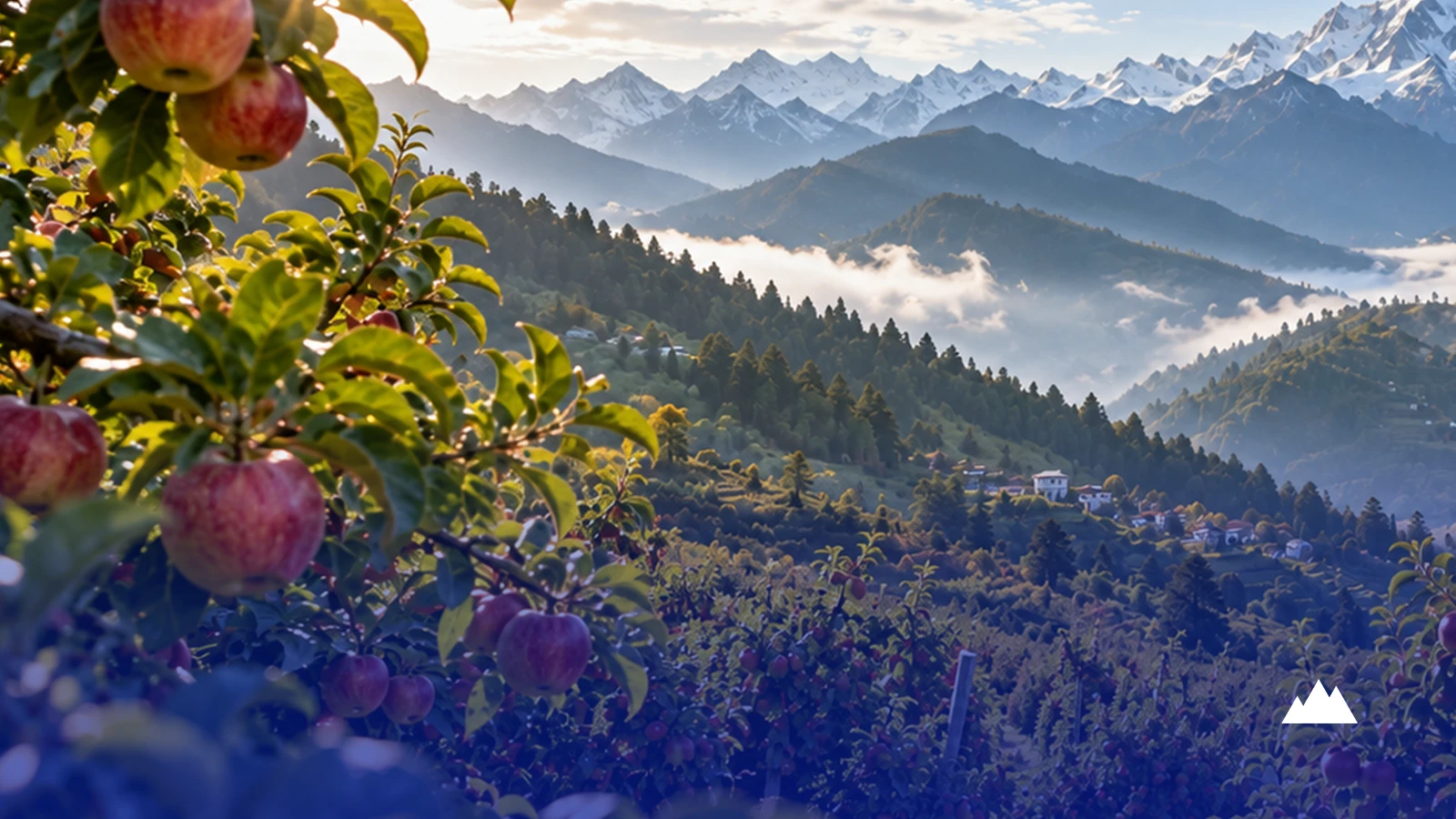
Procurers in Rohru opened this season at Rs 130 a kilo. One firm went to Rs 145. Last year the same buyers started at Rs 92, and the year before that growers were complaining about both the crop and the rate.
So the mood in the upper Shimla belt is not what the production figures would suggest. The Department of Horticulture expects around 4.36 lakh metric tonnes this year, roughly 2.15 crore boxes, against 6.99 lakh MT and 3.49 crore boxes last season. Arrivals through August were running at about half the volume of the corresponding period in 2025. A grower in Rohru put it to The Tribune in the way most of them are putting it: the crop is poor, but the prices have cushioned it.
They have. That is precisely the problem, and it is worth being unsentimental about why.
Two bad years in three is not a run of bad luck
Look at what has actually been marketed over six seasons.
| Season | Boxes marketed (crore) |
|---|---|
| 2020-21 | 2.40 |
| 2021-22 | 3.05 |
| 2022-23 | 3.36 |
| 2023-24 | 2.11 |
| 2024-25 | 2.51 |
| 2025-26 | 3.49 |
| 2026 (estimate) | 2.15 |
Source: Department of Horticulture, Government of Himachal Pradesh
The 2023-24 season saw boxes fall from 3.36 crore to 2.11 crore. This year the fall is 3.49 crore to an estimated 2.15 crore. Two contractions of nearly identical severity in three years, with a good season wedged between them.
What has widened is not the trend but the amplitude. The gap between a good year and a bad one has opened up to the point where the six-year average has stopped describing any season a grower has actually lived through. This matters commercially, not just statistically. A mean that describes nothing is a mean nobody can borrow against, insure against, or write a procurement contract on. It is also, incidentally, the number that goes into state budget projections.
The crop has been moving for a decade and the infrastructure hasn't
Apple is a chilling crop. The traditional varieties want somewhere between 1,200 and 1,600 hours below 7 degrees Celsius; the early varieties get by on about 600. Across the mid-hills, temperatures have risen by 1 to 1.5 degrees. The arithmetic does the rest.
What has followed is not abandonment but relocation. Cultivation has climbed something like a thousand feet above its historic bands. Orchards are now commercially productive in places that were agronomically implausible when most of the current generation of growers inherited their land: Lahaul-Spiti over the Rohtang, the stretch between Tabo and Kaza, Pangi and Bharmour in Chamba, Kalpa and Pooh and Sangla in Kinnaur. Y.S. Parmar University of Horticulture and Forestry at Solan runs a research station at Tabo now. Its work has recorded yield declines of 25 to 40 per cent in the old belts even while the new frontier opens above them.
Meanwhile the apparatus built to service the crop has not moved an inch. Link roads, controlled-atmosphere stores, grading and packing sheds, the APMC yards, the extension staff, the credit relationships that took thirty years to establish: all of it was capitalised for an orchard map that is dissolving underneath it. Apple area has gone from roughly 400 hectares in 1950-51 to about 1,16,338 hectares in 2024-25, close to half of Himachal's 2.37 lakh hectares under fruit, supporting around 2.5 lakh families. Very little of that installed capacity sits above 2,500 metres.
Nobody has written a depreciation schedule for a cold store in a belt that will not produce commercial volumes in fifteen years. Nobody in Shimla is being asked to.
The fiscal room is going, not coming
Himachal is entering this with a tight balance sheet. Outstanding liabilities are put at 40.5 per cent of GSDP by the end of 2026-27, against GSDP projected at Rs 2,77,497 crore. Agriculture and allied activities account for 14.3 per cent of state value added, and horticulture carries a disproportionate share of the work within that, because horticulture is the part that earns cash, services debt and keeps families in the villages rather than in Chandigarh.
The more consequential change is that the Sixteenth Finance Commission has recommended no revenue deficit grants to any state for 2026-31. The Fifteenth had recommended Rs 37,199 crore for Himachal across five years. The cushion that absorbed the last round of shocks has been withdrawn at exactly the point where the shocks stop being episodic.
Against that, the Market Intervention Scheme buys C-grade apples at Rs 12 a kilo. It is a floor under fruit that cannot be sold. Useful, but it was designed to handle a bad year, and what is happening is not a bad year.
What a transition budget would look like
Start with a plantation register keyed to altitude. The state knows its hectares perfectly well; it does not systematically know its elevation bands, varietal mix and chilling-hour exposure at plot level. Without that, every instrument built on top of it is priced blind. A grower at 1,900 metres and a grower at 2,800 metres are looking at opposite futures and are currently offered the same scheme.
Then site the new infrastructure where the fruit is going rather than where it has been. The roads into Pangi, Bharmour, Pooh and the Spiti valley are the marketing infrastructure of the 2040s. They are currently being planned, when they are planned at all, as tourism and connectivity work, with no horticultural logistics case attached.
And the mid-hills need a serious answer, because those belts are not going to sit empty. They will grow something. Stone fruit already accounts for 27,386 hectares, of which 17,306 are under cultivation. Cherry, plum, apricot, kiwi and pomegranate all carry lower chilling requirements. What none of them has is the marketing machinery that took the apple half a century to acquire, and building that is a ten-year job on which very little has started.
The danger in a good price
Rs 145 a kilo will be read in Shimla, and more importantly in Delhi, as evidence that the sector absorbs shocks well. It is the wrong reading. Revenue held up because output collapsed, which is what an inelastic market does in a scarcity year, and it works exactly once per scarcity. Repeat the shortfall in a year when Kashmir has a good crop or imports land heavily, and 2.5 lakh families meet the same volume loss with none of the price relief.
Himachal has perhaps a decade of transitional room while the upper belts come into bearing. Spent on relief, that decade buys very little. Spent on mapping, siting and replanting, it buys the state its second apple economy on reasonable terms.
The fruit has already chosen where it is going. Whether the roads, the stores and the credit turn up before or after it is a policy decision, and it is being made by default.